

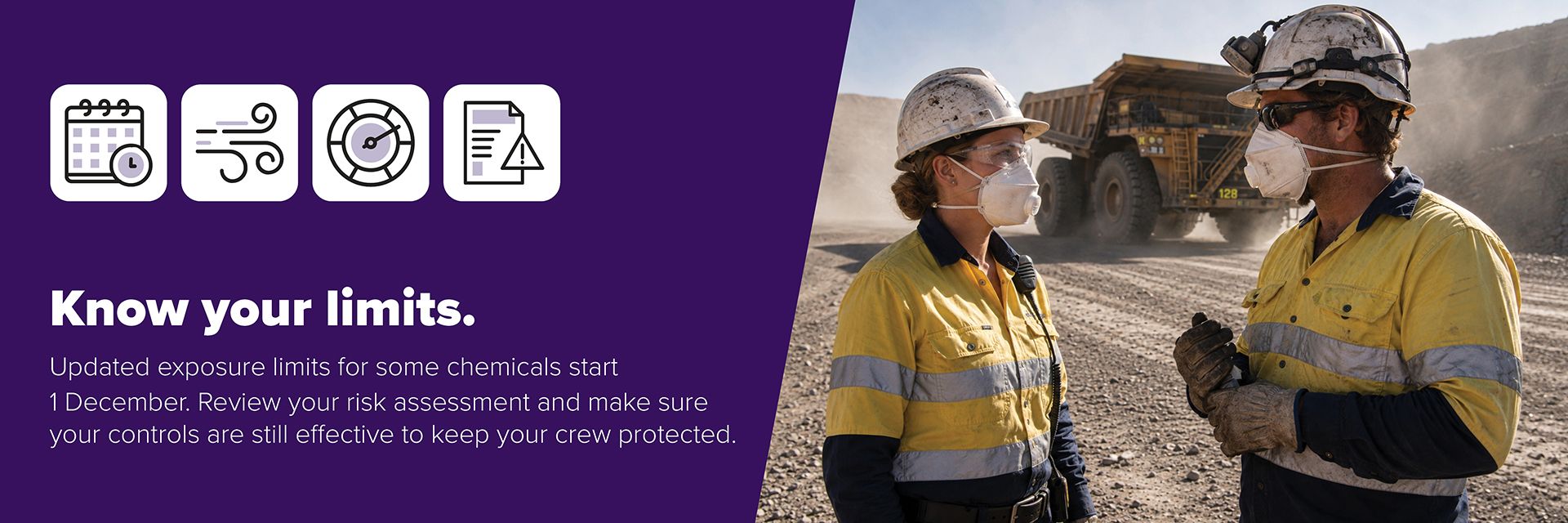
From 1 December 2026, updated workplace exposure limits (WEL) for airborne contaminants such as dust, chemicals, fumes, gases, fibres and vapours apply across Western Australia. In mining, workers may be exposed to airborne contaminants during drilling, blasting, crushing, hauling and when working with chemicals or explosives.
Exposure to airborne contaminants can affect worker health. In some cases, health effects may occur quickly. In others, illness can develop after repeated exposure over many years. This is one reason effective exposure management plays a key role in preventing occupational disease. You are most at risk when:
- working in poorly ventilated areas
- dry, windy or hot weather, which can increase exposure.
Airborne contaminants in mining
Dust
Dust is the most common airborne contaminant in mining. You can breathe in dust when:
- drilling, blasting, or crushing rock and ore
- transporting, loading or dumping material
- working around stockpiles or tailings
- cleaning or maintaining mining equipment
- working in underground or enclosed environments.
Mining dust can contain:
- silica particles from quartz-containing rock
- asbestos fibres in some ore bodies
- toxic metals, such as lead and arsenic
- manganese compounds from specific ore bodies
- coal dust in coal mines.
These come from the ore and rock being mined, as well as mining equipment.
Chemical contaminants
Chemical contaminants are a significant airborne hazard in mining. You may be exposed when:
- mixing or using explosives or blasting agents
- handling chemicals for ore processing or extraction (e.g., cyanide, acids)
- cleaning or maintaining processing equipment
- applying chemical dust suppressants.
These substances can become airborne when they are handled or mixed, or if they are spilled.
Gases and fumes
Gases and fumes are another serious airborne hazard in mining. You may be exposed when:
- blasting, which can release toxic gases such as nitrogen dioxide and carbon monoxide
- welding, soldering or cutting metals
- working near processing plants or smelters, where gases such as sulphur dioxide may be released
- working in confined or poorly ventilated areas.
These substances can build up quickly underground or in enclosed spaces, posing serious health and safety risks.
What mine operators need to do
Preparation may include identifying airborne contaminants used, handled or generated in the workplace, reviewing whether revised exposure limits apply, examining available exposure monitoring data and assessing existing control measures. Some organisations may also choose to seek specialist occupational hygiene advice to better understand the implications of the revised limits.
Keeping exposure to a minimum protects your workers’ health, today and for the future.
Resources and guidance
We have developed airborne contaminants resources for mine operators, workers, health and safety representatives and work health and safety professionals to support the transition to the updated WELs.