

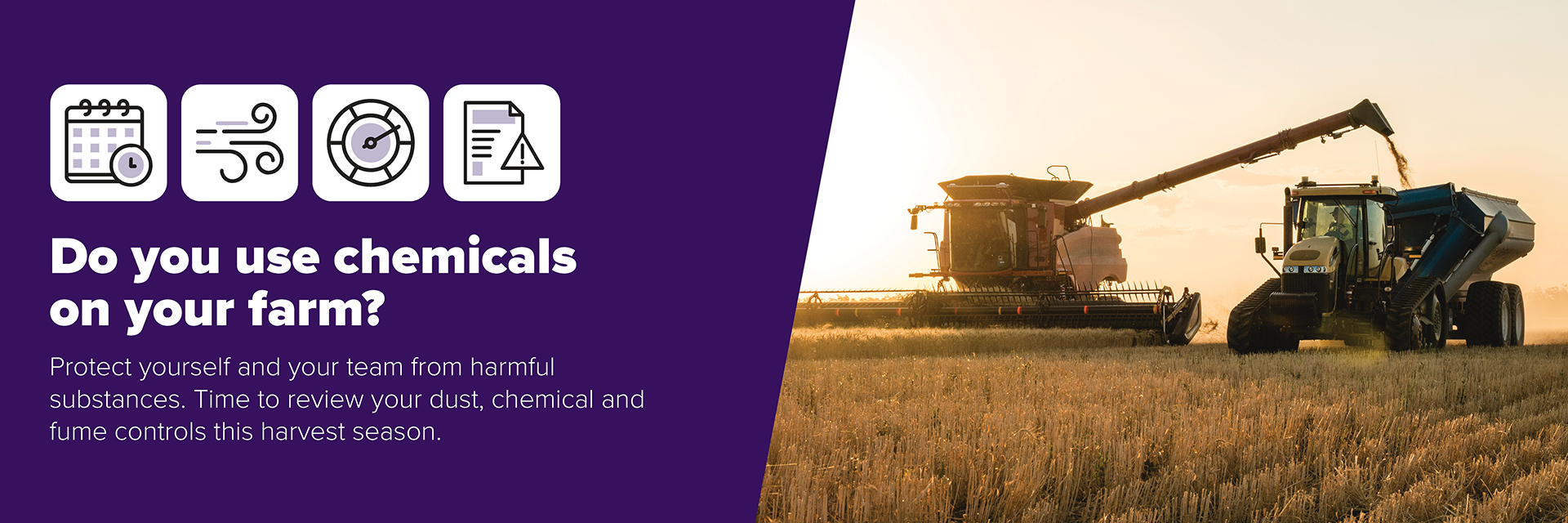
From 1 December 2026, updated workplace exposure limits for airborne contaminants such as dust, chemicals, fumes, gases, mould and organic matter apply across Western Australia. In agriculture, workers may be exposed to airborne contaminants such as grain dust, pesticides, fertilisers, chemical mixing and smoke from burning.
Airborne contaminants can be present in many agricultural tasks, but some situations put workers at higher risk than others. You are most at risk when:
- working in enclosed or poorly ventilated areas
- windy, dry or hot weather can make exposure worse.
Airborne contaminants on farms
Dust
Dust is the most common airborne contaminant in agriculture. You can breathe in dust when:
- handling grain, hay, straw or feed
- cleaning out silos, sheds or animal housing
- working with soil during harvesting or seeding
- using fertiliser or seed
- working in poultry or livestock sheds.
Dust can contain:
- grain particles
- soil and silica
- mould spores
- animal dander and manure particles
- biological contaminants.
These come from plants, animals and organic materials.
Chemical contaminants
Chemical contaminants are a common airborne hazard in agriculture. You may be exposed to them when:
- mixing, spraying or handling chemicals
- cleaning equipment, sheds, or animal housing
- working with fertilisers or pesticides
- handling grain, feed or soil treated with chemicals.
These substances often originate from agricultural products, soil and equipment. Chemical contaminants become airborne when mixed, sprayed or handled.
Gases and fumes
Gases and fumes are another significant airborne hazard in agriculture. Even small amounts can be dangerous. You may be exposed to gases and fumes when:
- entering manure or effluent pits
- using or storing fertilisers
- running engines, pumps or generators in enclosed spaces
- welding, soldering, or cutting metals
- burning vegetation or waste.
These substances can build up quickly in confined or poorly ventilated areas, posing serious health and safety risks.
What you need to do
Employers must:
- identify airborne hazards
- review all chemicals and substances used on your farm
- make sure tractors, harvesters and other equipment are maintained to limit fumes and dust
- update risk assessments and keep safety records up to date
- ensure all workers know about the updated workplace exposure limits and how to use controls like enclosed cabs, respirators or ventilation.
- provide information and training in a language everyone understands.
Keeping exposure to a minimum protects your workers’ health—now and for the future.
Resources and guidance
- How to identify airborne contaminant hazards on farms: Information sheet
- How to identify airborne contaminant hazards on farms: Case study
- How to identify airborne contaminant hazards on farms: Checklist
We have developed airborne contaminants resources for employers, workers, health and safety representatives, work health and safety professionals, and small businesses to support the transition.