

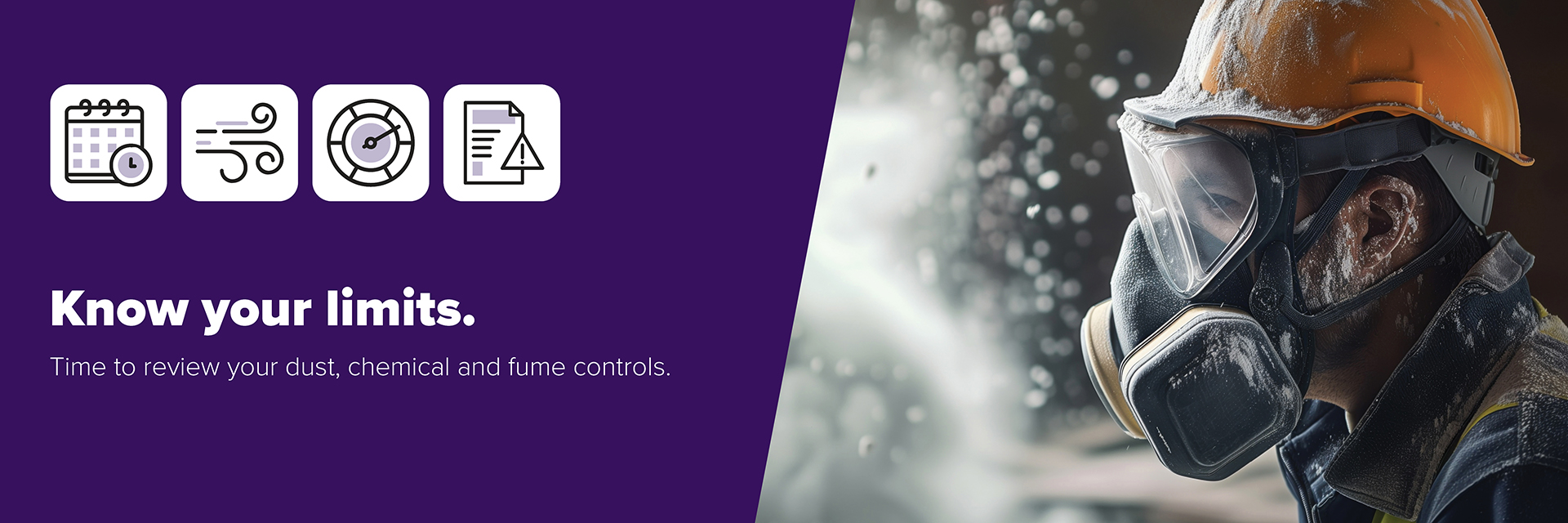
Workers can be exposed to airborne contaminants when using hazardous chemicals or carrying out work processes such as those involving:
- construction
- excavation
- tunnelling, quarrying and mining
- use of inorganic pesticides and herbicides
- use of machinery or equipment that generates dust or fumes
- cleaning
- painting.
As an employer and other duty holders, also known as a person conducting a business or undertaking (PCBU), you have a duty to ensure that no person at the workplace is exposed to a substance or mixture in an airborne concentration that exceeds the workplace exposure standards or limits.
What do workplaces need to do?
With the transition to workplace exposure limits (WELs) taking effect, workplaces should review potential exposures to hazardous chemicals and other airborne contaminants to ensure risks are effectively managed and control measures remain fit for purpose.
- Review your chemical inventory and identify any substances affected by the updated WEL. Safe Work Australia’s Hazardous Chemical Information System (HCIS) can help you find hazard classification information and workplace exposure limits.
- Review and improve control measures, such as substitution, isolation, ventilation, engineering controls and personal protective equipment.
- Conduct air and health monitoring where exposures may occur. Consider engaging an occupational hygienist if specialist advice is needed.
- Update risk assessments, safety data sheets and safe work procedures.
- Consult with workers and ensure they understand any changes affecting their work.
- Access free WorkSafe resources and guidance in multiple languages.
Managing risks in the workplace
As a PCBU, you must manage the risk in the workplace by eliminating airborne contaminants if it is reasonably practicable. If it isn’t reasonably practicable to eliminate exposure, PCBUs must minimise exposure to the airborne contaminant so far as is reasonably practicable. For some carcinogens where no safe level of exposure can be established, businesses must eliminate or minimise exposure so far as is reasonably practicable.
In many cases, compliance with the regulations can be achieved through basic, well-known exposure controls. This could include controls such as eliminating the process that is causing the hazard, for example, using silica-free bench top material or substituting hazardous substances with less harmful ones such as using granular or liquid formulations instead of powder.
You must also ensure that no person at the workplace is exposed to a substance or mixture in an airborne concentration that exceeds the exposure limit for that substance or mixture.
You may also have mandatory work health and safety duties in relation to health and air monitoring for airborne contaminants and the usage, handling and storage of hazardous chemicals, as well as specific duties in relation to crystalline silica, asbestos and lead.
Air monitoring
Air monitoring involves measuring the level of an airborne contaminant in the breathing zone of workers using a personal sampler during their usual work activities, including routine breaks. It is necessary to determine whether there is a risk to health.
Air monitoring may be needed to ensure that your workers are not exposed to airborne concentrations of a substance that exceed the workplace exposure standard or limit. Results from air monitoring can also indicate how effective your workplace controls, such as ventilation systems, are operating.
The Work Health and Safety (General) Regulations 2022 also have specific requirements for air monitoring when asbestos removal requires a Class A asbestos removal licence. More information on air monitoring for asbestos can be found in the How to safely remove asbestos: Code of practice.
If you are unsure whether air monitoring is required, you can consult an occupational hygienist for advice. An occupational hygienist can assist with reviewing your risk assessment and where required can establish a plan for exposure monitoring, conduct the monitoring and report on the results.
Health monitoring
Health monitoring involves using medical tests to assess and protect a worker’s health in response to hazardous chemicals.
It is not an alternative to implementing effective control measures according to the hierarchy of controls. Health monitoring provides you, as a PCBU, with information about the control measures used in the workplace. It lets you know whether control measures are ineffective or whether a worker’s health is being affected by exposure to hazardous chemicals, so that action can be taken.
Health monitoring is carried out by or supervised by a registered medical practitioner (a doctor) with experience in health monitoring.